 By Saksham Arora
 As factory buses enter through its large KIADB gateway, Narasapura begins another busy manufacturing day. Two-wheelers move towards dispatch yards, electronics workers enter high-security campuses, and component suppliers prepare daily consignments for automotive and engineering companies.
Narasapura Industrial Area is a major KIADB-developed manufacturing zone in Kolar district, Karnataka. Located along the Bengaluru–Kolar corridor, it has grown into an important centre for automobiles, electronics, aerospace components, engineering products and industrial logistics. The estate has been developed in phases, beginning with around 700 acres and followed by much larger expansion plans.
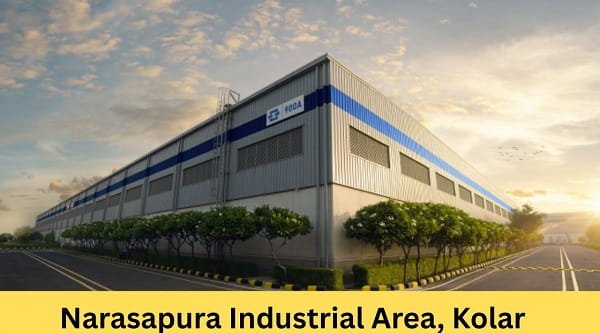
Narasapura Industrial Area Overview
| Particular | Details |
| Location | Narasapura, Kolar district, Karnataka |
| Alternative spelling | Narsapura |
| Industrial authority | Karnataka Industrial Areas Development Board |
| Area character | Large automotive, electronics and engineering cluster |
| Main highway | NH-75 or Bengaluru–Kolar Highway |
| Nearest city | Kolar |
| Nearby industrial areas | Vemgal, Malur and Hoskote |
| Nearest railway options | Kolar and Malur railway stations |
| Direct metro service | Not available |
| Nearest major airport | Kempegowda International Airport |
| Major industries | Two-wheelers, electronics, aerospace and auto components |
| Suitable for | Large factories, suppliers, warehouses and export-oriented units |
Where Is Narasapura Industrial Area Located?
Narasapura Industrial Area lies close to Narasapura village between Hoskote and Kolar. It is positioned beside NH-75, formerly known as NH-4 or Old Madras Road, making it accessible from eastern Bengaluru, Kolar and the Andhra Pradesh-facing corridor.
The industrial estate is approximately 15 km from Kolar city. Factories are distributed across different phases and industrial roads, so visitors should obtain the complete plot number, phase, gate and map location before travelling.
Narasapura should not be confused with Vemgal or Malur Industrial Area. All three are important manufacturing locations in Kolar district, but they have separate layouts, factory addresses and access roads.
Connectivity
1. Road Connectivity
NH-75 is the principal road serving Narasapura Industrial Area. It connects the estate with Hoskote, KR Puram and Bengaluru towards the west and with Kolar, Mulbagal and Andhra Pradesh towards the east.
The Bengaluru–Kolar section of NH-75 is planned for expansion into a ten-lane corridor, including six central lanes and service roads. The project is intended to handle growing freight traffic generated by industrial estates such as Narasapura. Until the entire expansion is completed, businesses should continue to plan for congestion around Hoskote, toll plazas and industrial entry points.
Narasapura also benefits from connections with the Satellite Town Ring Road and Bengaluru–Chennai Expressway network. However, the final approach to some factory plots may involve service roads or internal industrial roads.
2. Railway Connectivity
Kolar and Malur railway stations are the nearest practical rail options, both located roughly within the wider 15-km range depending on the factory’s exact position. Kolar connects with Bengaluru and Bangarapet, while Malur lies on the important Bengaluru–Chennai railway corridor.
Bangarapet Junction provides broader long-distance railway connectivity. Passenger rail is useful for employees and visitors, but most industrial materials are transported by road.
A nearby passenger railway station does not automatically provide freight-loading or private-siding facilities to individual factories.
3. Bus and Employee Transport
Government buses and private vehicles connect Narasapura with Kolar, Hoskote and nearby villages. Public transport is generally easier to find on NH-75 than inside distant industrial phases.
Major companies operate employee buses because factories run multiple shifts and workers commute from Kolar, Hoskote, Bengaluru and surrounding settlements.
4. Airport Connectivity
Kempegowda International Airport is the nearest major airport. It is useful for business visitors, aerospace executives and time-sensitive electronic components.
The journey normally involves regional roads towards Devanahalli or outer Bengaluru. Ordinary automotive components and heavy industrial materials are generally transported by road rather than air.
Facilities in Narasapura Industrial Area
1. Industrial Plots and Factory Campuses
The estate contains large KIADB plots, modern production plants, supplier factories, warehouses and engineering workshops. Its phased development provides space for major manufacturing campuses as well as smaller ancillary businesses.
Investors purchasing a resale KIADB plot should verify the original allotment, transfer approval, permitted activity, construction deadline and outstanding industrial-authority dues.
2. Automotive Manufacturing Ecosystem
Honda Motorcycle & Scooter India operates its third Indian manufacturing plant at Narasapura. The facility is one of the company’s major two-wheeler plants and has an annual capacity of around 2.4 million units.
Honda’s presence has encouraged the development of clutch, brake, lighting, belt, plastic, machining and engineering-component suppliers. Vendors working with large automobile manufacturers may require certified quality systems, traceability and regular customer audits.
3. Electronics Manufacturing
The former Wistron iPhone-assembly factory in Kolar was acquired by Tata Electronics in 2023. Tata Electronics now operates the Narasapura facility as part of its electronics-manufacturing business.
In 2025, ₹193 crore was approved for working-women’s hostels and water facilities supporting the Tata Electronics workforce in Narasapura. The infrastructure was planned for completion over an 18-month period, so its exact current status should be checked locally.
4. Aerospace and Precision Engineering
Mahindra Aerospace has a manufacturing facility in the Narasapura industrial region. The company produces aerostructures and precision assemblies used in aircraft programmes.
The wider engineering ecosystem also supports CNC machining, tooling, fabricated parts, surface treatment and industrial testing.
5. Power, Water and Internal Infrastructure
The estate was planned with multi-lane access roads, streetlights, underground power infrastructure and separate pipelines for potable and treated water. Power capacity and water availability can still differ between industrial phases and individual plots.
Factories should confirm sanctioned electrical load, transformer capacity, water allocation, drainage and wastewater-treatment requirements before starting production.
Major Industries
Narasapura Industrial Area supports:
- Two-wheeler manufacturing
- Smartphones and electronic products
- Aerospace structures and components
- Automotive brakes, clutches and lighting
- Rubber belts and moulded products
- Precision machining and fabrication
- Plastic automotive components
- Warehousing and industrial logistics
Company List in Narasapura Industrial Area
| Company | Main Activity |
| Honda Motorcycle & Scooter India | Motorcycles and scooters |
| Tata Electronics | Electronics and smartphone assembly |
| Mahindra Aerospace/Aerostructures | Aircraft structures and assemblies |
| Scania India-associated facility | Commercial vehicles and industrial operations |
| Exedy Clutch India | Clutch systems and automotive components |
| Bando India | Industrial belts and rubber products |
| ASK Automotive | Braking and two-wheeler components |
| Suprijit Engineering | Automotive cables and control systems |
| Lumax supplier units | Automotive lighting and components |
Honda, Tata Electronics and Mahindra Aerospace are major anchor businesses. Several other automotive suppliers are publicly associated with Narasapura, but individual plant activity and occupancy should be confirmed before visiting.
Why Businesses Choose Narasapura Industrial Area
Narasapura offers highway access, large industrial plots and proximity to Bengaluru’s engineering talent. Its automotive and electronics anchor companies create opportunities for component manufacturers, packaging businesses, maintenance contractors and logistics providers.
The estate is also connected with the wider Hoskote–Kolar–Malur manufacturing corridor. Its main challenges include employee commuting, water availability, freight congestion and varying levels of development between phases.
Frequently Asked Questions
Q1. Are Narasapura and Vemgal the same industrial area?
A: No. They are separate KIADB estates in Kolar district. Narasapura is located closer to NH-75, while Vemgal lies on another industrial corridor.
Q2. Can any company become a Honda or Tata Electronics supplier?
A: Not automatically. Suppliers usually need quality certification, production audits, financial capability, material traceability and the ability to meet strict delivery schedules.
Q3. What should be checked before buying a KIADB resale plot?
A: Check the allotment letter, lease-cum-sale conditions, transfer approval, production deadlines, outstanding dues, sanctioned construction and permitted industrial activity.
Q4. Is Narasapura suitable for employee commuting from Bengaluru?
A: Daily commuting is possible, particularly from eastern Bengaluru and Hoskote, but company-operated buses are generally more practical than depending entirely on public transport.
Q5. Can an automotive warehouse be converted into a production factory?
A: Only after verifying industrial land use, building approval, electrical capacity, fire clearance, pollution requirements and KIADB permission for the proposed manufacturing process.