 By Saksham Arora
 Before the main markets of Faridabad open, Sarurpur is already working to the sound of furnaces, cutting machines and loading vehicles. Metal is melted inside compact casting units, sheets are shaped in fabrication workshops, and finished components move towards larger factories across Faridabad and the wider Delhi-NCR region.
Sarurpur Industrial Area, also written as Saroorpur Industrial Area, is an established manufacturing pocket in western Faridabad. It has developed around Sarurpur village and nearby colonies rather than inside a single planned, gated estate. The area primarily accommodates small and medium-sized factories engaged in metal casting, forging, fabrication, machining, plastic processing and industrial repair.
Its position within Faridabad’s broad engineering ecosystem gives businesses access to workers, suppliers and customers. However, road width, utility capacity, drainage and the legal status of industrial activity can differ considerably between individual properties.
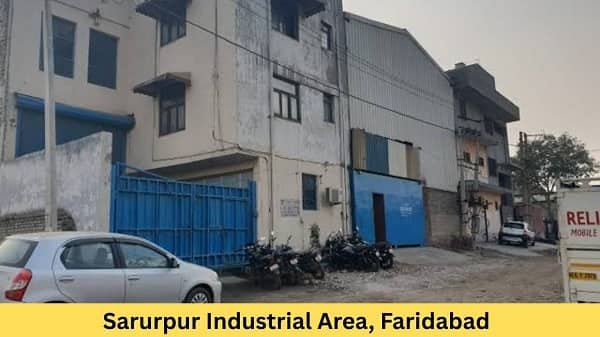
Sarurpur Industrial Area Overview
| Particular | Details |
| Location | Sarurpur village and surrounding industrial pocket, Faridabad, Haryana |
| Alternative spelling | Saroorpur Industrial Area |
| Area type | Mixed industrial, village and residential cluster |
| Administrative region | Faridabad district |
| PIN code | Depends on the exact property and postal address |
| Main approach roads | Sohna Road, Pali Road and roads through NIT Faridabad |
| Nearest metro options | Escorts Mujesar, Sant Surdas–Sihi or Raja Nahar Singh, depending on the unit |
| Nearest railway options | Faridabad New Town and Ballabhgarh railway stations |
| Nearby localities | Nangla, Dabua, Pali, NIT Faridabad, Mujesar and Ballabhgarh |
| Major industries | Casting, forging, fabrication, plastics and engineering |
| Suitable for | MSMEs, workshops, small factories, warehouses and supplier units |
Sarurpur does not have one uniform entrance or a centrally managed layout. The complete factory address, nearby landmark and contact details are therefore essential when visiting.
Where Is Sarurpur Industrial Area Located?
Sarurpur Industrial Area is located around Sarurpur village on the western side of Faridabad. It lies within the wider industrial belt extending through Nangla, Dabua, Pali Road, Mujesar and Ballabhgarh-facing areas.
The locality contains a mixture of factories, workers’ housing, shops, village properties and residential colonies. Some industrial units stand along wider connecting roads, while others operate from interior streets.
Published reports use both Sarurpur and Saroorpur for the locality. Visitors must also avoid confusing it with Sarurpur Kalan in Baghpat district or other similarly named villages in Uttar Pradesh. Recent local reporting clearly identifies Sarurpur village and Sarurpur Colony as parts of Faridabad.
Connectivity
1. Road Connectivity
Sarurpur is connected with the wider city through roads leading towards Sohna Road, Pali Road, Dabua Colony, NIT Faridabad and Ballabhgarh. These routes provide onward access to Mathura Road or NH-44.
The Pali Road side is useful for movement towards Pali village, Dhauj and the Faridabad–Gurugram Road. Routes through NIT Faridabad connect the area with central Faridabad, while the Ballabhgarh side supports travel towards southern industrial sectors and the Delhi–Mumbai Expressway corridor.
Road conditions vary inside the industrial pocket. Small commercial vehicles, pickup vans and mini-trucks can reach most factory clusters, but large trailers may experience difficulty inside narrow streets. Loading space should be inspected before selecting a factory or warehouse.
Traffic can become slow during factory shifts and school hours. Heavy vehicles may also require carefully planned entry and exit timings because several roads are shared with residential traffic.
2. Metro Connectivity
There is no Delhi Metro station inside Sarurpur Industrial Area. The most practical station depends on the exact factory location.
Escorts Mujesar Metro Station may be useful for properties approached through the Mujesar and NIT sides. Sant Surdas–Sihi and Raja Nahar Singh Metro stations are more suitable for units approached through Ballabhgarh.
These stations are on Delhi Metro’s Violet Line, which connects Faridabad with Badarpur, South Delhi, Central Delhi and Kashmere Gate. Employees generally complete the remaining journey by auto, e-rickshaw, shared vehicle or company transport.
3. Railway Connectivity
Faridabad New Town Railway Station is useful for factories located towards the Mujesar and NIT sides. Ballabhgarh Railway Station may be more convenient for units approached from the southern side.
Both stations are situated on the Delhi–Mathura railway corridor. Local passenger trains support employee movement between Delhi, Faridabad, Ballabhgarh and Palwal.
Faridabad Railway Station is another option for long-distance passengers, although the final road journey to Sarurpur is longer than from the nearer suburban stations.
4. Bus and Local Transport
Autos, e-rickshaws, shared vehicles and local buses operate in the wider Nangla, Dabua, NIT and Ballabhgarh region. Public transport is easier to find on main roads than inside factory lanes.
Many workers commute by motorcycle, bicycle or employer-operated vehicle. Visitors travelling late in the evening should arrange return transport beforehand because shared services may become less frequent inside the industrial pocket.
5. Airport Connectivity
Indira Gandhi International Airport is the nearest major airport for domestic and international business travel. It can be reached through Faridabad’s road links towards Delhi.
The airport is useful for company executives and customers, but routine industrial cargo from Sarurpur primarily moves by road.
Facilities in Sarurpur Industrial Area
1. Factory and Workshop Space
Sarurpur contains small factory buildings, independent workshops, casting units, fabrication sheds and storage premises. Many properties combine production, warehousing and office activities within the same compound.
The area is mainly suitable for MSMEs rather than businesses requiring a large landscaped manufacturing campus. Factory size, floor strength, ceiling height and loading facilities differ from one building to another.
Businesses using overhead cranes, furnaces or heavy machines must inspect the structure carefully before finalising a property.
2. Electricity and Water
Industrial electricity connections are available in parts of the locality, but the sanctioned load must be verified separately for every premises. A connection previously used for a warehouse or light workshop may not support casting, moulding or heavy engineering machinery.
Water arrangements may include authorised supply, storage tanks or other permitted sources. Units using water for cooling, cleaning or industrial processing must check availability and wastewater-disposal requirements.
Power backup is important for businesses operating CNC machines, compressors, furnaces or continuous production lines.
3. Roads, Drainage and Waste Collection
Infrastructure is not uniform throughout Sarurpur. Some main roads provide reasonable commercial-vehicle access, while interior lanes may have limited width, irregular surfaces or roadside parking.
Drainage and waterlogging should be checked during the monsoon. Factory owners should also confirm how municipal waste, metal scrap, furnace residue and packaging waste are collected.
Industrial waste should never be mixed with ordinary household garbage or dumped on vacant land.
4. Fire and Worker Safety
Factories using furnaces, hot metal, welding equipment, oils or chemicals require strong safety systems. These may include fire extinguishers, emergency exits, protective clothing, machine guards and clearly marked storage areas.
Adequate ventilation is especially important inside casting, painting, welding and plastic-processing units. Worker training and periodic inspection are necessary because many Sarurpur factories operate from compact premises.
5. Environmental Compliance
Casting and forging are among the industrial activities publicly associated with the area. A confirmed factory record from Saroorpur identifies furnace-based casting activity within the locality.
Units producing smoke, dust, wastewater or hazardous waste may require consent from the Haryana State Pollution Control Board. Faridabad inspections have found metal-casting and forging units operating without valid permissions, using unauthorised fuels or dumping slag and ash in the open.
Businesses must therefore verify pollution consent, permitted fuel, land use, fire approval and factory registration for the individual premises.
6. Daily-Use Facilities
Tea stalls, small restaurants, grocery stores, pharmacies and repair shops are available around Sarurpur village and the adjoining colonies.
More organised banking, healthcare, accommodation and shopping facilities are available towards NIT Faridabad, Ballabhgarh and central Faridabad. The wider city also provides transporters, machine repair services, tool suppliers and industrial consultants.
Major Industries in Sarurpur
Metal casting and forging form an important part of Sarurpur’s manufacturing profile. Small factories produce cast components, forged items and basic parts used by engineering and automobile businesses.
Fabrication workshops handle cutting, welding, drilling and shaping of metal. The area also accommodates machine shops, plastic-processing units, packaging businesses and industrial repair services.
Faridabad itself is a major manufacturing centre with a strong base in tractors, automotive components, electrical equipment, tyres, footwear and engineering products. Sarurpur’s smaller units often work as suppliers or subcontractors within this wider network.
Company and Business List in Sarurpur Industrial Area
Sarurpur contains many small privately owned factories whose trade names, tenancy and operating status may change. The following is a representative list of identifiable companies and common business types in the locality:
| Company or Business Type | Main Activity |
| Shri Vardhman Casting | Furnace-based metal casting |
| Independent metal foundries | Iron and non-ferrous cast components |
| Forging workshops | Forged engineering parts and industrial items |
| Fabrication units | Cutting, welding and structural metal work |
| Machine shops | Turning, drilling and component machining |
| Plastic-processing units | Moulded plastic parts and industrial products |
| Industrial repair workshops | Motor, machinery and equipment maintenance |
| Warehousing and packaging units | Storage, packing and local distribution |
Shri Vardhman Casting has been publicly identified as operating in Saroorpur Industrial Area. However, a published name should not be treated as confirmation that a factory is currently active or open to visitors.
Customers, suppliers and job applicants should verify the official address, GST details, contact person and present operating status before travelling.
Why Businesses Choose Sarurpur Industrial Area
Sarurpur’s main advantage is its connection with Faridabad’s established manufacturing network. Small factories can reach component suppliers, skilled workers, transporters and industrial customers without moving far outside the city.
The area can be suitable for businesses that need compact and comparatively practical production space. Casting, fabrication, machining, repair and supplier operations can benefit from proximity to larger industrial districts.
At the same time, every property requires individual verification. Road access, power load, drainage, pollution permissions and approved land use may differ even between neighbouring buildings.
Frequently Asked Questions
Q1. Why is the area written as both Sarurpur and Saroorpur?
A: Both spellings are used in local addresses and public records. The spelling shown on the company’s official registration and postal documents should be followed.
Q2. Does Sarurpur have a formally published plot-number system?
A: Not throughout the entire locality. Many addresses depend on street names, village references and nearby landmarks, so map coordinates and contact details are often necessary.
Q3. Can a large trailer enter every factory lane?
A: No. Several internal roads are narrow or shared with residential traffic. Trailer turning space and loading access must be checked at the individual property.
Q4. What should job applicants confirm before visiting a factory?
A: They should verify the company name, exact location, interviewer’s contact details and whether any fee has been demanded. Genuine employers normally do not ask candidates to pay for an interview.
Q5. Can a property registered as a warehouse be used for manufacturing?
A: Not automatically. Manufacturing may require suitable land use, electricity load, pollution approval, fire clearance and other permissions depending on the process.