 By Saksham Arora
 Before the markets of North-West Delhi open, Kanjhawala’s business roads are already moving. Delivery vans travel between workshops, building-material stores receive supplies, and small manufacturing and storage units prepare goods for Delhi, Bahadurgarh, Mundka and Bawana.
Kanjhawala is an emerging industrial location in North-West Delhi. Local workshops and warehouses already operate around the wider area, but it should not yet be described as a fully developed industrial estate comparable to Bawana or Narela. In October 2025, the Delhi government finalised a proposal to develop new planned industrial areas at Kanjhawala, Rani Khera and Baprola. Later official reviews referred to continuing development work in Kanjhawala, but a complete public timetable for plot allotment and full operation was not available in the latest reports found.
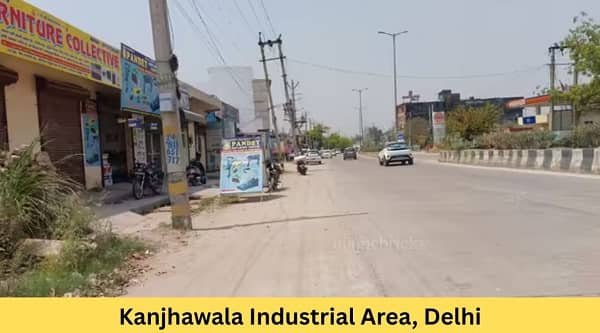
Overview Kanjhawala Industrial Area, Delhi
| Particular | Details |
| Location | Kanjhawala, North-West Delhi |
| Common PIN code | 110081 |
| Present character | Mixed village, commercial, warehouse and small-industry zone |
| Planned development | Proposed organised industrial area |
| Main approach roads | Kanjhawala Road, Karala–Kanjhawala Road and Bawana Road |
| Direct metro station | Not available |
| Useful metro options | Mundka, Mundka Industrial Area and Rithala, depending on the route |
| Useful railway options | Mundka and Ghevra suburban stations |
| Nearby areas | Karala, Rani Khera, Ghevra, Mundka, Bawana and Rohini |
| Common activities | Warehousing, fabrication, furniture, packaging and repair work |
| Suitable for | MSMEs, godowns, workshops and local distribution |
Kanjhawala is also the administrative headquarters of North-West Delhi district. Its location places it between several established industrial centres, including Mundka, Bawana and Bahadurgarh.
Where Is Kanjhawala Industrial Area Located?
Kanjhawala lies in Delhi’s outer north-western belt, close to Karala, Rani Khera, Ghevra and the newer sectors of Rohini. The locality contains village settlements, government offices, shops, warehouses and scattered industrial premises.
It is not currently one enclosed estate with a single entrance. Business addresses may mention Kanjhawala, Ladpur Road, Karala Road, Ghevra Road or a nearby colony. Visitors should carry the complete plot or khasra number and a map location.
The planned industrial-development proposal may eventually create a more organised estate. Until official allotment maps and development phases are published, buyers should not assume that every property advertised as an “industrial plot” belongs to a notified government industrial scheme.
Connectivity
1. Road Connectivity
Kanjhawala Road connects the locality with Rohini, Mangolpuri and the inner parts of North-West Delhi. The Karala–Kanjhawala Road provides access towards Karala and Mundka, while routes towards Bawana connect the area with one of Delhi’s largest manufacturing estates.
The wider western belt also benefits from Urban Extension Road-II. UER-II has strengthened access between outer Delhi, Dwarka, Mundka and major national highways, although businesses must use the correct interchange and local approach road. A barrier-free tolling system began operating at the Mundka–Bakkarwala toll plaza in May 2026.
A proposed 10.7-km traffic corridor between Kanjhawala Chowk and Mangolpuri is under feasibility study. It may include flyovers, underpasses or other traffic-management structures, but it is not yet completed infrastructure.
2. Metro Connectivity
There is no Delhi Metro station directly inside Kanjhawala. Mundka and Mundka Industrial Area stations on the Green Line are useful for travel through the western side. Rithala on the Red Line may be more practical for passengers approaching from Rohini.
Autos, buses, shared vehicles or company transport are required for the final journey. Mundka station is an operational Green Line station on Rohtak Road, while Mundka Industrial Area station serves the surrounding factory and warehouse corridor.
3. Railway and Bus Connectivity
Mundka and Ghevra are useful suburban railway options for the surrounding western Delhi belt. Train frequency is limited compared with major Delhi stations, so most employees depend on buses and road transport.
DTC and cluster buses operate through Kanjhawala and nearby villages. Public transport is easier to obtain on the main road than near interior workshops or late-night industrial shifts.
Facilities in Kanjhawala Industrial Area
1. Industrial and Warehouse Properties
The wider locality contains independent godowns, workshops, small factories and open storage properties. Common premises include ground-floor sheds, village-side commercial buildings and plots used for warehousing.
Property standards differ significantly. Gate width, floor strength, loading space and fire-engine access must be inspected individually.
2. Power and Water
Electricity and water connections are available across developed sections, but businesses should verify the sanctioned category and capacity. Machinery, welding equipment, compressors or plastic-processing units may require an industrial power connection rather than an ordinary commercial supply.
Water source, drainage and wastewater-disposal arrangements should also be checked before starting production.
3. Drainage and Monsoon Conditions
Waterlogging has been a major concern along the Karala–Kanjhawala corridor. Work on a ₹22.16-crore stormwater drain from Jain Nagar to Kanjhawala Chowk began in December 2025, with the drain designed to connect to the Mungeshpur system.
Businesses considering ground-floor storage should inspect road level, drain outlets and warehouse-floor height during or after rainfall.
4. Daily-Use Services
Banks, fuel stations, restaurants, pharmacies and repair services are available around Kanjhawala’s main market and government-office area. Larger hospitals, hotels and organised commercial facilities are available towards Rohini, Mundka and Bahadurgarh.
Major Business Activities
Kanjhawala presently has a mixed small-business profile rather than one dominant manufacturing sector. Common activities include:
- Warehousing and local distribution
- Metal fabrication and welding
- Furniture and woodwork
- Packaging and carton production
- Automobile and machinery repair
- Electrical products and servicing
- Plastic and household products
- Construction-material storage
The future planned estate may attract cleaner and more organised industries, but its permitted sectors will depend on the final government scheme.
Company and Business Profile
A dependable official directory of active companies in Kanjhawala is not publicly available. Publishing unverified names could incorrectly present a workshop, registered office or closed unit as an operating factory.
| Business Category | Typical Activity |
| Warehouse operators | Storage and Delhi-NCR distribution |
| Fabrication workshops | Cutting, welding and metal structures |
| Furniture units | Wooden furniture and interior products |
| Packaging businesses | Cartons, labels and packing materials |
| Automobile workshops | Repairs, spare parts and servicing |
| Electrical-service firms | Motor and equipment maintenance |
| Building-material traders | Hardware, panels and construction supplies |
Customers and job applicants should verify the GST name, complete address and current operating status before visiting any unit.
Why Businesses Consider Kanjhawala
Kanjhawala offers access to Mundka, Bawana, Bahadurgarh, Rohini and Delhi’s outer-road network. It can suit workshops and warehouses serving western and north-western Delhi.
Its future potential depends on the planned industrial scheme, drainage improvement and better road connectivity. Businesses should base present decisions on the legal status and infrastructure of the individual property—not only on future development announcements.
Frequently Asked Questions
Q1. Is Kanjhawala already a fully operational DSIIDC industrial estate?
A: Not in the same sense as Bawana or Narela. A planned industrial-area proposal is under development, while existing businesses are spread across the wider locality. Buyers should request the official allotment or title documents for the specific property.
Q2. Which documents are most important before purchasing an industrial plot?
A: Check the registered title or lease deed, approved land use, mutation and revenue records, building sanction, outstanding dues and whether industrial activity is legally permitted. An advertisement calling land “industrial” is not sufficient proof.
Q3. Can a warehouse property be used for manufacturing?
A: Not automatically. Manufacturing may require different land-use permission, industrial electricity, fire clearance, factory registration and pollution-control consent.
Q4. What should a business inspect before the monsoon?
A: Check warehouse-floor height, nearby drains, road slope, past waterlogging marks, electrical-panel position and whether trucks can enter when surrounding roads are flooded.
Q5. Will UER-II and the proposed Kanjhawala–Mangolpuri corridor solve truck-access problems?
A: They can improve regional connectivity, but final access still depends on local roads, junctions and the factory entrance. The Kanjhawala–Mangolpuri corridor remains under planning, so it should not be included as an existing advantage in a property valuation.