 By Saksham Arora
 Morning in Hoskote begins with factory buses arriving from eastern Bengaluru, trucks entering warehouse campuses and precision-manufacturing units preparing components for automotive, engineering and export customers. Its position between Bengaluru, Kolar and the Chennai-facing corridor has made Hoskote an important industrial and logistics destination.
Hoskote Industrial Area refers to the KIADB-developed estate and the wider manufacturing belt around Hoskote town in Bengaluru North district. Industrial activity is spread across areas near Hoskote, Dandupalya, Katamnallur, Nandagudi and the NH-75 corridor. It includes traditional factories, precision-engineering units, commercial-vehicle manufacturing and modern logistics parks.
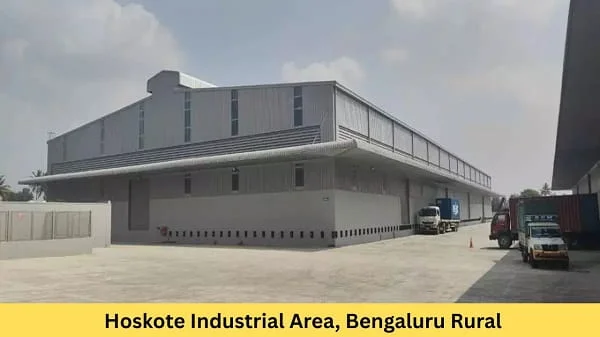
Hoskote Industrial Area Overview
| Particular | Details |
| Location | Hoskote, eastern Bengaluru region, Karnataka |
| Common PIN code | 562114 |
| Industrial authority | Karnataka Industrial Areas Development Board |
| Area character | Manufacturing, engineering and logistics corridor |
| Main highway | NH-75 or Old Madras Road |
| Expressway connection | Bengaluru–Chennai Expressway near Hoskote |
| Other major corridor | Satellite Town Ring Road |
| Nearest railway options | Whitefield, Kadugodi and Malur |
| Direct metro service | Not available inside the industrial area |
| Nearest major airport | Kempegowda International Airport |
| Major industries | Automotive, precision engineering, metal components and warehousing |
| Suitable for | Factories, supplier units, warehouses and fulfilment centres |
Where Is Hoskote Industrial Area Located?
Hoskote lies on Bengaluru’s eastern side, between KR Puram and Kolar. The town functions as an important gateway for traffic travelling from Bengaluru towards Kolar, Mulbagal and Andhra Pradesh.
The industrial estate is not limited to one entrance or one group of plots. Factory addresses may mention KIADB Industrial Area, Hoskote, Dandupalya, Katamnallur, Nandagudi or another nearby village. Hoskote’s common postal code is 562114.
Visitors should obtain the complete plot number, village name, gate and live location before travelling. Two businesses described as being in Hoskote may be several kilometres apart.
Connectivity
1. Road Connectivity
NH-75, historically known as Old Madras Road, is the principal route connecting Hoskote with KR Puram, Whitefield-facing roads and central Bengaluru. In the opposite direction, it continues towards Kolar, Mulbagal and the Andhra Pradesh–Tamil Nadu side.
Hoskote also benefits from the Satellite Town Ring Road. The corridor improves outer-ring connectivity towards Devanahalli, Doddaballapur, Dabaspet and other industrial areas without requiring all commercial traffic to enter central Bengaluru. Industrial demand has increased along the STRR stretch between Dabaspet and Hoskote because of improved road connectivity and access to Bengaluru’s airport region.
The Karnataka section of the Bengaluru–Chennai Expressway begins near the Hoskote side and provides a high-speed route towards Kolar and the Chennai corridor. Tolling was introduced on the operational Karnataka section between Hedigenabele near Hoskote and Sundarapalya.
Businesses should still inspect the last-mile road because some plots are reached through village roads or service lanes.
2. Metro Connectivity
There is no operational Namma Metro station inside Hoskote Industrial Area. The Purple Line terminus on the Whitefield–Kadugodi side is the nearest metro access for many commuters, followed by a road journey to Hoskote.
Businesses should not advertise a Hoskote factory as directly metro-connected. Employee buses, BMTC services, private vehicles or taxis are required for the final stretch.
3. Railway Connectivity
Whitefield and Kadugodi are useful railway options for industrial locations closer to Bengaluru. Malur Railway Station may be more convenient for factories on the eastern side of Hoskote.
Passenger rail can support employee and visitor movement, but industrial consignments normally travel by road. Proximity to a railway line does not provide a factory with automatic freight or siding access.
4. Bus and Local Transport
BMTC services connect Hoskote with KR Puram, Tin Factory, Budigere Cross and other parts of Bengaluru. Routes also connect Hoskote with northern employment centres such as Manyata Tech Park.
Local buses and shared vehicles are easier to obtain around Hoskote town and NH-75. Large factories and logistics parks generally arrange employee transport for shift workers.
5. Airport Connectivity
Kempegowda International Airport is the nearest major airport. Access is possible through Budigere Cross, Devanahalli-facing roads and the wider STRR network.
Airport proximity is particularly useful for executives, urgent components and high-value cargo. Bulk industrial goods are usually more economical by road.
Facilities in Hoskote Industrial Area
1. Industrial Plots and Factory Buildings
The Hoskote belt contains KIADB industrial plots, independent manufacturing campuses, production sheds and privately developed industrial parks. Property sizes range from smaller engineering units to large automotive and logistics facilities.
Before purchasing a resale KIADB plot, investors should verify the original allotment, lease conditions, permitted activity, transfer approval, construction status and outstanding dues.
2. Precision Manufacturing Ecosystem
Hoskote has developed a strong precision-engineering base. INDO-MIM operates from KIADB Industrial Area, Hoskote, producing metal-injection-moulded parts, precision components, investment castings and additive-manufacturing products for automotive, aerospace, medical and industrial applications.
Such companies create opportunities for tooling businesses, machine shops, heat-treatment providers, industrial automation firms and quality-testing services.
3. Automotive and Commercial Vehicles
The Hoskote industrial belt has a long association with Volvo truck production. Volvo’s first truck manufactured in India was produced at its Hoskote plant, and the location remains associated with Volvo and Volvo Eicher commercial-vehicle operations.
Automotive suppliers should be prepared for strict standards related to material traceability, testing, delivery schedules and vendor audits.
4. Warehousing and Fulfilment Centres
Hoskote has become a major warehousing location because of its highway access and proximity to Bengaluru’s eastern consumption market.
Mapletree Hoskote Logistics Park provides large modern warehouse buildings, while Prozo added two Hoskote fulfilment centres measuring approximately 75,000 and 76,000 square feet in 2026.
Warehouse operators should check dock height, floor load, fire systems, vehicle parking and labour availability before selecting a facility.
5. Power, Water and Safety
Industrial electricity is available, but the sanctioned load and transformer capacity vary by property. CNC machines, furnaces, compressors and automated warehouse equipment may require high-tension power and backup systems.
Water availability, borewell permission, drainage and wastewater disposal must be checked separately. Factories handling oils, chemicals, metal treatment or combustible packaging need pollution approval, safe storage and suitable fire-protection systems.
Major Industries
Hoskote supports:
- Commercial vehicles and automotive components
- Metal injection moulding and precision parts
- Industrial machinery and fabrication
- Aerospace and medical components
- Warehousing and e-commerce fulfilment
- Packaging and distribution
- Additive manufacturing and tooling
- Engineering maintenance services
Company List in Hoskote Industrial Area
| Company or Facility | Main Activity |
| INDO-MIM Limited | Precision metal components and advanced manufacturing |
| Volvo Trucks/VECV facility | Commercial vehicles and related manufacturing |
| Mapletree Hoskote Logistics Park | Industrial and logistics space |
| Prozo fulfilment centres | Multi-client storage and order fulfilment |
| Precision-engineering MSMEs | Machining, tooling and fabricated components |
| Warehouse operators | Storage and Bengaluru distribution |
| Automotive suppliers | Vehicle parts and industrial assemblies |
The list is representative. Some facilities are located in the wider Hoskote corridor rather than within the same KIADB layout, and current operating addresses should be verified before visiting.
Why Businesses Choose Hoskote
Hoskote offers access to Bengaluru’s market while avoiding some of the property and congestion pressures of central industrial areas. NH-75, STRR and the Bengaluru–Chennai corridor support movement towards Bengaluru, Kolar, the airport region and neighbouring states.
Its established precision-engineering companies and growing logistics ecosystem make it suitable for manufacturing, supplier businesses and regional distribution. The main limitations are the absence of direct metro access, uneven last-mile roads and dependence on organised employee transport.
Frequently Asked Questions
Q1. Is Hoskote Industrial Area the same as Narasapura Industrial Area?
A: No. Hoskote is in the Bengaluru region, while Narasapura is a separate KIADB estate farther east in Kolar district.
Q2. Can a warehouse in Hoskote be used for manufacturing?
A: Not automatically. The occupier must verify land use, approved building purpose, industrial electricity, fire clearance and permissions required for the proposed production process.
Q3. What should be checked before buying a KIADB resale plot?
A: Check the allotment letter, lease-cum-sale conditions, transfer approval, production deadlines, outstanding dues, sanctioned plan and permitted industrial category.
Q4. Is the Bengaluru–Chennai Expressway fully operational up to Chennai?
A: The Karnataka section near Hoskote has opened for tolled travel, but businesses should verify the status of the complete route before planning time-sensitive deliveries.
Q5. What should companies arrange for night-shift workers?
A: Factories should examine employee buses, safe pickup points, lighting, security, canteen facilities and emergency medical support because public transport becomes limited inside industrial roads at night.