 By Saksham Arora
 Morning in Vasanthanarasapura begins with factory buses arriving from Tumakuru, workers entering large manufacturing campuses and trucks carrying machinery, metal parts and packaged goods moving through the KIADB roads. The wide industrial plots and expanding production zones give the area a very different character from the crowded industrial estates found inside major cities.
Vasanthanarasapura Industrial Area is a large manufacturing township on the outskirts of Tumakuru, Karnataka. Developed by the Karnataka Industrial Areas Development Board, it is divided into multiple phases and accommodates general manufacturing units, food-processing businesses, engineering companies and a dedicated Japan Industrial Township.
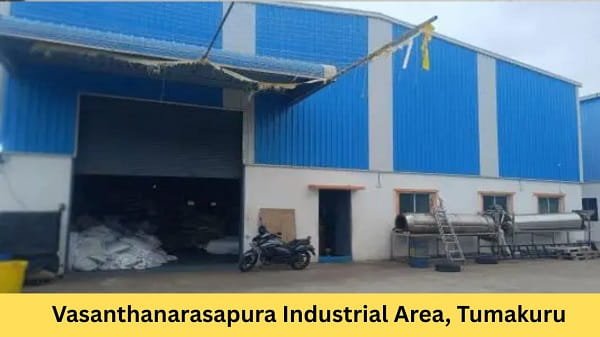
Vasanthanarasapura Industrial Area Overview
| Particular | Details |
| Location | Outskirts of Tumakuru, Karnataka |
| Industrial authority | Karnataka Industrial Areas Development Board |
| Industrial structure | Multiple phases and specialised industrial clusters |
| Major specialised cluster | Japan Industrial Township |
| Main regional road | Bengaluru–Tumakuru highway corridor |
| Nearest major railway station | Tumakuru Railway Station |
| Direct metro facility | Not available |
| Nearest major airport | Kempegowda International Airport, Bengaluru |
| Nearby areas | Tumakuru city, Hiregundagal, Kora and surrounding villages |
| Major industries | Engineering, automotive components, food processing and precision manufacturing |
| Suitable for | Large factories, Japanese companies, MSMEs and warehouses |
The industrial township has expanded through several phases. A May 2025 report stated that development work in Phases 4, 5 and 6 was nearing completion and that these sections could also accommodate future IT and IT-enabled businesses.
Where Is Vasanthanarasapura Industrial Area Located?
Vasanthanarasapura Industrial Area lies outside the central part of Tumakuru city. It forms part of the wider Tumakuru–Bengaluru industrial corridor and is approximately 90 km from Bengaluru, according to KIADB officials quoted during the announcement of the second Japan Industrial Park.
The estate covers a large area and includes separate phases, internal roads and specialised clusters. A company address may mention Vasanthanarasapura Phase 1, Phase 2, Phase 3 or one of the newer development stages.
Visitors should confirm the phase, plot number, company gate and nearby village before travelling. Entering the wrong phase can add considerable travel time because factories are spread across a broad industrial township.
Connectivity
1. Road Connectivity
Vasanthanarasapura is connected with Tumakuru city and the Bengaluru–Tumakuru highway corridor. This provides access towards Bengaluru, Nelamangala and Dabaspet on one side and towards other parts of central and northern Karnataka through Tumakuru.
The location is suitable for industries transporting machinery, components and finished goods between Bengaluru and northern Karnataka. The planned industrial expansion is also associated with the Chennai–Bengaluru Industrial Corridor, strengthening its long-term importance for manufacturing and export-oriented investment.
Internal roads are generally planned for industrial movement, but conditions may differ between older and developing phases. Companies expecting regular trailer traffic should inspect road width, gate access, turning space and loading arrangements at the individual plot.
2. Railway Connectivity
Tumakuru Railway Station is the nearest major passenger railway facility. It lies on the Bengaluru–Hubballi railway route and provides connections towards Bengaluru, Davanagere, Hubballi, Belagavi and other cities.
Tumakuru is also served by important intercity trains, including services connecting Bengaluru with northern Karnataka. Employees and visitors normally complete the final journey from the railway station by bus, taxi, company vehicle or private transport.
There is no railway station directly inside the industrial township, so businesses cannot depend entirely on rail for daily last-mile employee transport.
3. Bus and Local Transport
KSRTC buses connect Tumakuru with Bengaluru and surrounding towns. Local buses and private vehicles serve villages around the industrial area, but direct frequency may differ by phase and shift timing.
Large factories generally arrange employee buses from Tumakuru city and nearby residential areas. Workers employed in night shifts should confirm whether company transport is available because public options may become limited after regular working hours.
4. Metro and Airport Connectivity
There is no operational Namma Metro connection to Vasanthanarasapura or Tumakuru. Metro expansion towards Tumakuru has been discussed, but it should be treated as future infrastructure rather than an existing travel option.
Kempegowda International Airport is the nearest major airport. Tumakuru city is commonly placed around 90 km from the airport, although the actual journey from an industrial plot depends on the chosen road and traffic conditions.
Facilities in Vasanthanarasapura Industrial Area
1. Industrial Plots and Factory Space
The township contains large KIADB plots, production campuses, engineering sheds and space for supporting warehouses. The different phases allow both established manufacturers and new industries to consider properties according to their land and infrastructure requirements.
The area is particularly suitable for companies that require larger plots than those commonly available inside Bengaluru’s older industrial estates.
2. Japan Industrial Township
Vasanthanarasapura has an existing Japan Industrial Township spread across about 160 acres. By November 2025, KIADB officials described this township as fully allotted, with 107 companies, including Toyota, receiving land.
A second Japan-specific industrial park of approximately 300 acres was also announced in 2025. It is intended for Japanese manufacturers and suppliers working in areas such as automotive components, electronics, machine tools and precision engineering. The project should not be presented as fully operational until its development and allotment stages are officially completed.
3. Power, Water and Utilities
KIADB industrial layouts generally include planned roads, power distribution, water systems and designated utility areas. However, the available electricity load and water capacity must be confirmed for each plot.
Companies installing furnaces, compressors, CNC machines, refrigeration systems or heavy production lines should examine transformer capacity, backup power, water storage and drainage before beginning operations.
4. Environmental and Safety Facilities
Manufacturing units must arrange fire-safety systems, waste storage, pollution-control equipment and wastewater treatment according to their industrial activity.
Food-processing, metal-treatment, chemical and engineering companies may have different consent requirements. Existing permission for one activity does not automatically allow a tenant to begin another type of manufacturing.
Worker and Daily-Use Services
Basic shops, small restaurants and local services are available in surrounding settlements. Tumakuru city provides larger hospitals, banks, hotels, rental housing, educational institutions and organised commercial facilities.
Companies with a large workforce often provide transport, canteen and medical facilities because the industrial township is located away from the central city.
Major Industries
Vasanthanarasapura supports and is being developed for industries such as:
- Automotive parts and assemblies
- Precision engineering products
- Machine tools and industrial machinery
- Electrical and electronic components
- Food processing and packaging
- Metal fabrication
- Warehousing and logistics
- IT and technology-support operations
The proposed second Japan Industrial Park is expected to focus particularly on advanced manufacturing, electronics and precision-engineering companies.
Company and Industrial Cluster List
A complete public tenant directory is not regularly available. The following list represents confirmed or officially reported industrial presence:
| Company or Cluster | Main Activity |
| Toyota-linked allotment | Automotive and related industrial activity |
| Japan Industrial Township companies | Precision engineering, components and manufacturing |
| Food-processing units | Processing, packaging and storage |
| Engineering manufacturers | Machinery and fabricated components |
| Automotive suppliers | Parts, assemblies and technical products |
| Electrical and electronics units | Industrial and electronic components |
| Warehouse operators | Storage and regional distribution |
The existing Japan Industrial Township was reported to contain 107 allotted companies, but individual company names and operating status should be verified before publishing a detailed directory or visiting a factory.
Why Businesses Choose Vasanthanarasapura
Vasanthanarasapura offers large industrial plots, access to Tumakuru’s workforce and road connectivity with Bengaluru. Its phased layout provides space for both manufacturing plants and supporting supplier units.
The Japanese industrial cluster strengthens its appeal for automotive, electronics and precision-engineering businesses. Companies can also operate outside Bengaluru’s congested industrial core while remaining connected with the city’s markets and technical ecosystem.
Frequently Asked Questions
Q1. Are all phases of Vasanthanarasapura equally developed?
A: No. Older phases may have more established factories, while newer phases can still be undergoing infrastructure development or allotment. Businesses should inspect the exact phase rather than judging the entire township together.
Q2. Can any company obtain land inside the Japan Industrial Township?
A: Not automatically. The specialised township is intended mainly for eligible Japanese companies and related investments. Allotment depends on KIADB rules, project approval and available land.
Q3. What should be verified before buying an allotted industrial property?
A: Check the KIADB allotment letter, lease-cum-sale conditions, permitted activity, outstanding dues, transfer approval, building plan and whether the required production deadlines have been met.
Q4. Is employee transport necessary for factories in the area?
A: It is strongly advisable. The estate is outside central Tumakuru, and bus availability may not match early-morning, late-night or rotating factory shifts.
Q5. Can a warehouse plot be converted into a food or engineering factory?
A: Not without approval. The change may require revised land-use permission, additional power, fire clearance, factory registration and pollution-control consent.